Three years ago, if clients needed apps, they hired a software engineer.
Now many of them can build internal tools and MVPs without a technical background. They describe what they need and Claude Code gets it done for $100 per month. And they have what many engineers lack - domain expertise and enthusiasm.
So if agents do the implementing, what exactly is the future of software development?
I’ve been thinking about this for months.
Models stopped being autocomplete
Two years ago AI coding tools were suggestion engines. You typed, they completed. Useful, but you were still the one doing the work.
Today they’re much, much more powerful. They plan, execute, run the tests, and report back. Currently, Fable is the pinnacle of this, but OpenAI is catching up with its Sol model, and others aren’t far away (I’m most curious about open-source models in this regard)
Update, July 19: Moonshot released Kimi K3 - 2.8 trillion parameters, the largest open-weight model ever, with a 1M-token context window and built specifically for long-horizon agentic coding. On real-world knowledge-work benchmarks it lands just behind Fable 5 and Sol. Full weights drop July 27.
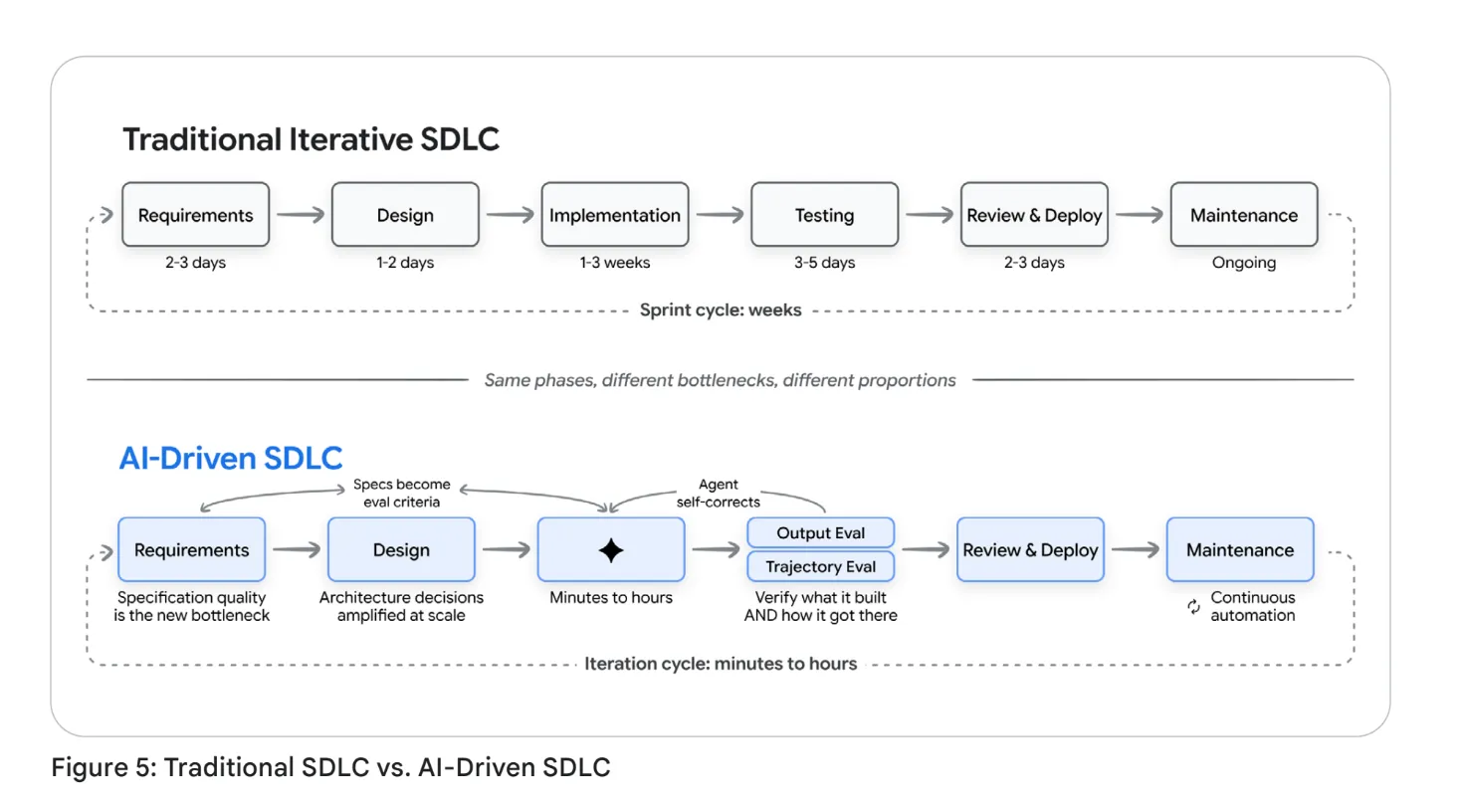
Google’s new paper The New SDLC With Vibe Coding (Osmani, Saboo, Kartakis — May 2026) tells this: AI compresses the software lifecycle unevenly. Implementation that took weeks now takes hours. Requirements, architecture, and verification are still human-paced. The developer’s role, in their words, shifts from primary implementor to “system designer and orchestrator.”
Value of expertise
Anthropic analyzed ~400,000 Claude Code sessions and that’s what they found:
- There’s a clear division of labor: people make about 70% of the planning decisions, the agent makes about 80% of the execution decisions. People decide what to build. The agent decides how.
- Domain expertise predicts success, not coding proficiency. Every major occupation — lawyers, managers, scientists — succeeds at coding tasks within a few points of software engineers. What separates winners is how well they understand the problem, not whether they’re trained in coding.
Agents don’t substitute for domain expertise. They amplify it.
Google’s paper have the similar conclusion. They call it “the shift from syntax to intent”: the skills that matter now are decomposition, evaluation, system design and context engineering — giving agents your domain knowledge, your conventions, your guardrails.
According to Anthropic’s research, the gap between intermediate and expert users is not too broad. A working understanding of the domain captures most of the benefit. You don’t need twenty years in an industry to direct agents well in it — you need enough understanding to know what confidently “correct” looks like (which still might take years to acquire).
The new bottleneck
The most expenisve thing in software engineering now is no longer writing code, it’s managing the agent loop.
Boris Cherny — the creator of Claude Code — says his job now is writing loops that prompt the agent, not prompting it himself. In one month, 100% of his contributions to Claude Code were written by Claude Code, 259 merged PRs.
When I created Claude Code as a side project back in September 2024, I had no idea it would grow to be what it is today. It is humbling to see how Claude Code has become a core dev tool for so many engineers, how enthusiastic the community is, and how people are using it for all… pic.twitter.com/QVlmbhjUUE
— Boris Cherny (@bcherny) December 27, 2025
Google’s paper has a name for the mental model that ties this together - the factory model. Your primary output is no longer code — it’s the system that produces code. Specs, agents, quality gates, feedback loops, guardrails.
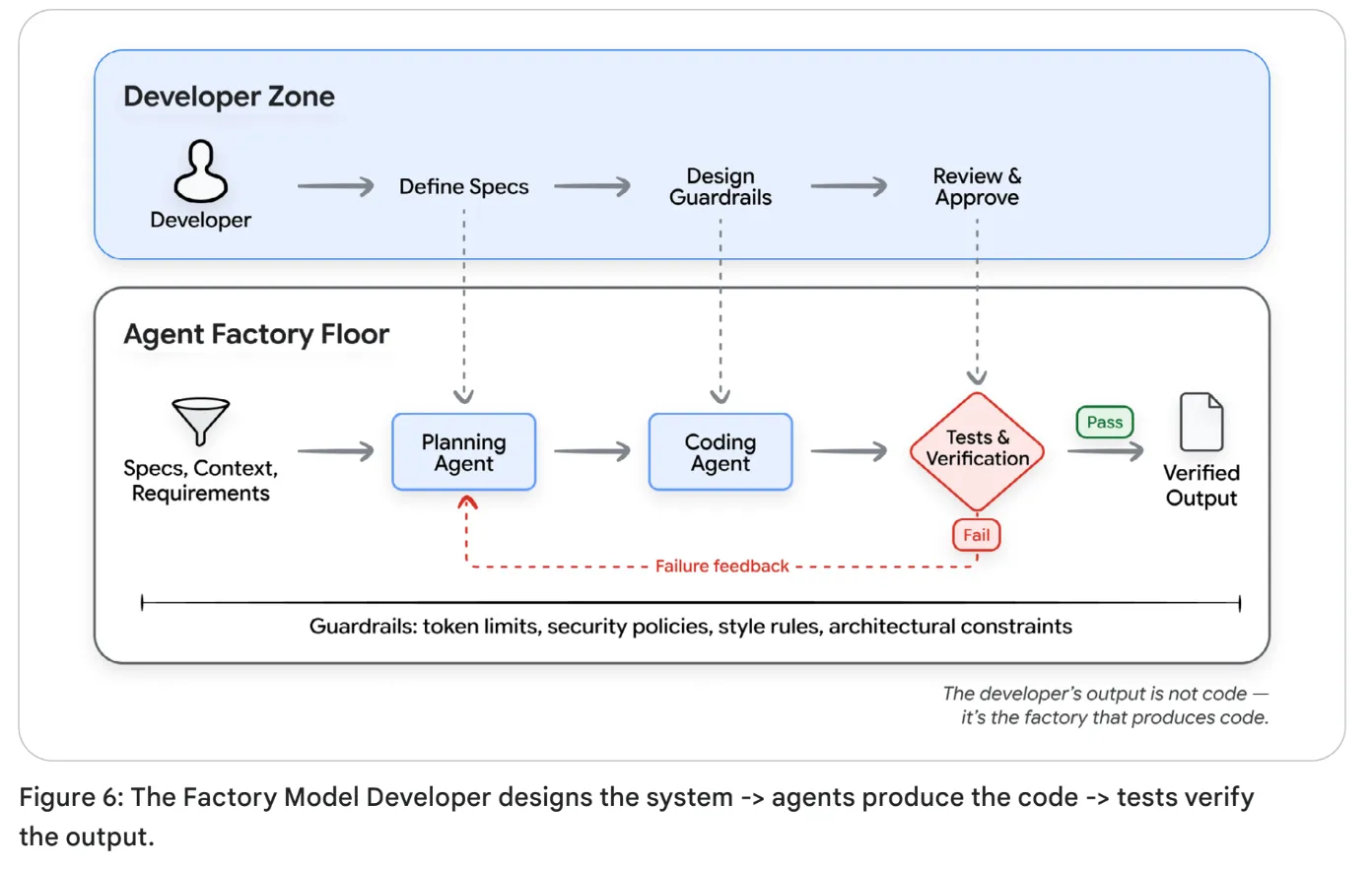
This matches what I’ve seen running agents in production for the last few years. The hard part is the harness. Why Tuesday’s run degraded, the cost guardrails that keep a retry loop from becoming a five-figure invoice. That’s the 20% in what Google calls the 80% problem: agents generate 80% of a feature fast, and the remaining 20% — edge cases, business logic, integration — demands exactly the contextual knowledge the models don’t have.
The job built for this era
There’s already a role that was designed for new reality, and it’s having a moment: the forward deployed engineer.
Andrew Ng called it one of the buzziest new jobs in Silicon Valley — OpenAI and Anthropic are both building teams to embed FDEs inside client organizations. The role is two decades old: Palantir pioneered it, famously shipping code overnight next to Special Forces units in Afghanistan, on the theory that you cannot build for an environment without being in it.
The anatomy of the job, as people doing it describe it: audit (sit with each team, map workflows, decide what should be automated and — just as important — what shouldn’t), evals (define what “great” looks like and measure the agent against it, because an executive spending millions needs proof, not vibes), and deployment (start with the smallest unit of autonomy, expand only when it earns trust).
The deal-breaker in this role is communication. If you can’t explain to a non-technical VP what AI can and can’t do, there won’t be a deployment. This is a skilled engineer who can understand a customer’s problem deeply, write code in a codebase they’ve never seen, and communicate the business impact to a non-technical decision maker. High-impact hire.
Software used to be limited by implementation. Now it’s limited by judgment. The people who understand reality better than the models will create the most value. Deciding that — inside a messy, real organization — is the job.