DeepSeek V4 Pro: $0.04. Kimi K3: $0.95. Claude Fable 5: $2.75.
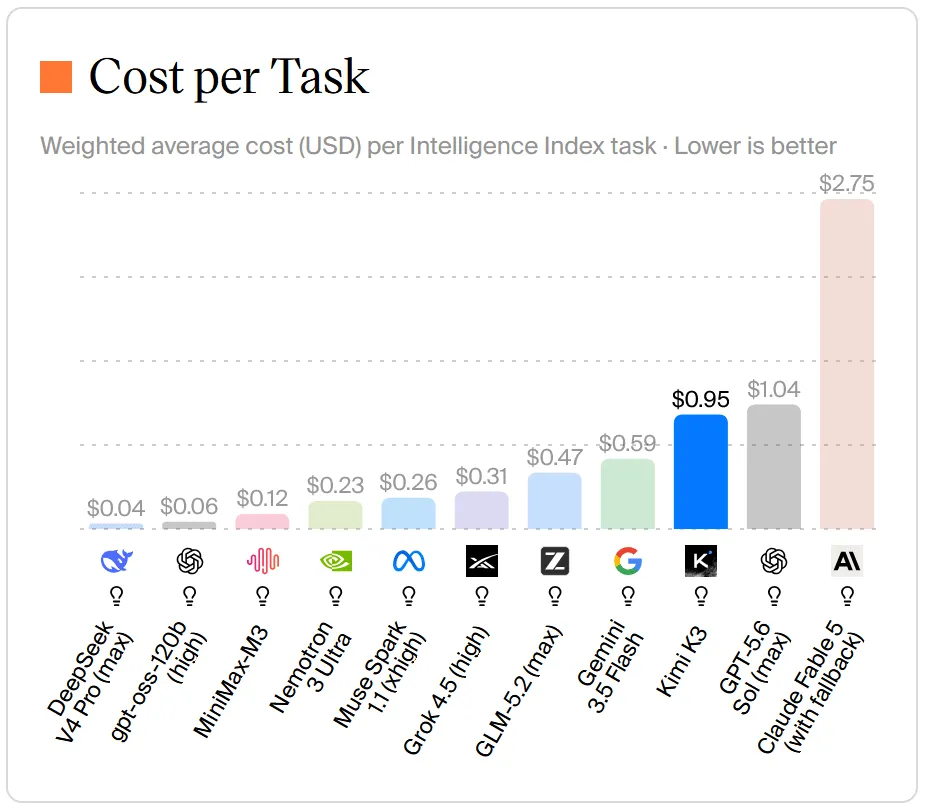
DeepSeek is 69x cheaper than Fable.
A big part of the answer is architecture - specifically two hybrid attention mechanisms, CSA and HCA. This article explores how they work, and what makes DeepSeek V4 so cheap.
Table of Contents
Open Table of Contents
Why attention matters
When a transformer generates a token, it looks back at every previous token. Each of those previous tokens sits in memory as a key-value (KV) entry — the KV cache.
Two costs grow with context length:
- Memory. A 1M-token conversation means a KV cache with a million entries, held in memory for every request.
- Compute. Attention cost grows quadratically with context length.
DeepSeek’s approach: compress attention using two different techniques.
How DeepSeek V4 compresses attention
flowchart LR
    T(["🔍 New token<br/>looks back at…"]) --> W
    T --> C
    T --> H
    W["<b>Sliding window</b><br/>last 128 tokens<br/>─────<br/>uncompressed<br/>full detail"]
    C["<b>CSA memory</b><br/>whole history, 4 → 1<br/>─────<br/>compressed<br/>selective recall"]
    H["<b>HCA memory</b><br/>whole history, 128 → 1<br/>─────<br/>heavily compressed<br/>global gist"]
Compression comes from two attention mechanisms: CSA and HCA. In V4-Pro’s 61-layer stack, the first two layers run HCA, layers 2–60 alternate between CSA and HCA, and the multi-token-prediction (MTP) block at the end runs sliding-window attention only. So it’s roughly a 1:1 interleave - with exceptions at both ends. Both mechanisms keep a sliding-window branch over the most recent tokens, so the newest context is never compressed.
CSA: compress, then pick what matters
Compressed Sparse Attention is the mid-range memory, and it does two things.
First, compression. Every 4 consecutive tokens get merged into a single KV entry via softmax-gated pooling with a learned positional bias — the model learns how to summarize each group of four, rather than just averaging them. The cache shrinks 4x.
Second, sparse retrieval. Even a 4x-smaller cache is too big to attend over densely at 1M tokens. So a lightweight module called the Lightning Indexer scans the compressed entries, scores their relevance to the current query, and picks only the most relevant compressed blocks — top-k, with k = 1024 in V4-Pro.
flowchart LR
    A["1M tokens"] -->|"compress<br/>4 → 1"| B["250K<br/>compressed entries"]
    B -->|"Lightning Indexer<br/>picks top 1024"| S["top-k blocks<br/>only"]
    S -->|"full attention"| AT(["✅ Answer"])
So CSA is compression and sparsity: the memory is 4x smaller, and the model only touches the slice of it that matters right now.
HCA: compress harder, look at everything
Heavily Compressed Attention makes the opposite. Instead of 4 tokens per entry, it packs 128 tokens into one - a cache 32x lighter than CSA’s.
At that size, DeepSeek doesn’t bother with sparse selection. The compressed cache is small enough that the model attends densely over all of it — no indexer, nothing skipped.
flowchart LR
    subgraph HCA_L["HCA — global"]
        direction LR
        B1["1M tokens"] -->|"128 → 1"| B2["~8K entries"]
        B2 -->|"cheap enough"| B3["attend to<br/>everything"]
    end
    subgraph CSA_L["CSA — precise"]
        direction LR
        A1["1M tokens"] -->|"4 → 1"| A2["250K entries"]
        A2 -->|"pick top-k"| A3["attend to<br/>a few blocks"]
    end
The two mechanisms are complementary:
| CSA | HCA | |
|---|---|---|
| Compression | 4 → 1 | 128 → 1 |
| Attention | Sparse (top-k blocks) | Dense (everything) |
| Character | Precise, selective | Cheap, global |
| Failure mode | Indexer misses a block | Detail lost in summary |
The receipts
The paper’s numbers, at 1M-token context versus DeepSeek’s own V3.2:
- V4-Pro: 27% of the inference FLOPs, 10% of the KV cache.
- V4-Flash: 10% of the FLOPs, 7% of the KV cache.
There are smaller optimizations stacked on top — most KV entries are stored in FP8 (with BF16 reserved for the RoPE dimensions), and the Lightning Indexer runs in FP4 throughout.
The other half of cheap: MoE
Attention is only part of the cost story. V4-Pro is a Mixture-of-Experts model with 1.6T total parameters but only 49B activated per token — roughly 3% of the network fires on any forward pass. V4-Flash is 284B total, 13B active.
Other factors
Beyond that, DeepSeek benefits from cheaper electricity, labor, chips and state backing.
Sources: DeepSeek-V4: Towards Highly Efficient Million-Token Context Intelligence · Sebastian Raschka’s CSA/HCA architecture notes · Hugging Face: DeepSeek-V4 deep dive · Artificial Analysis: DeepSeek V4 Pro